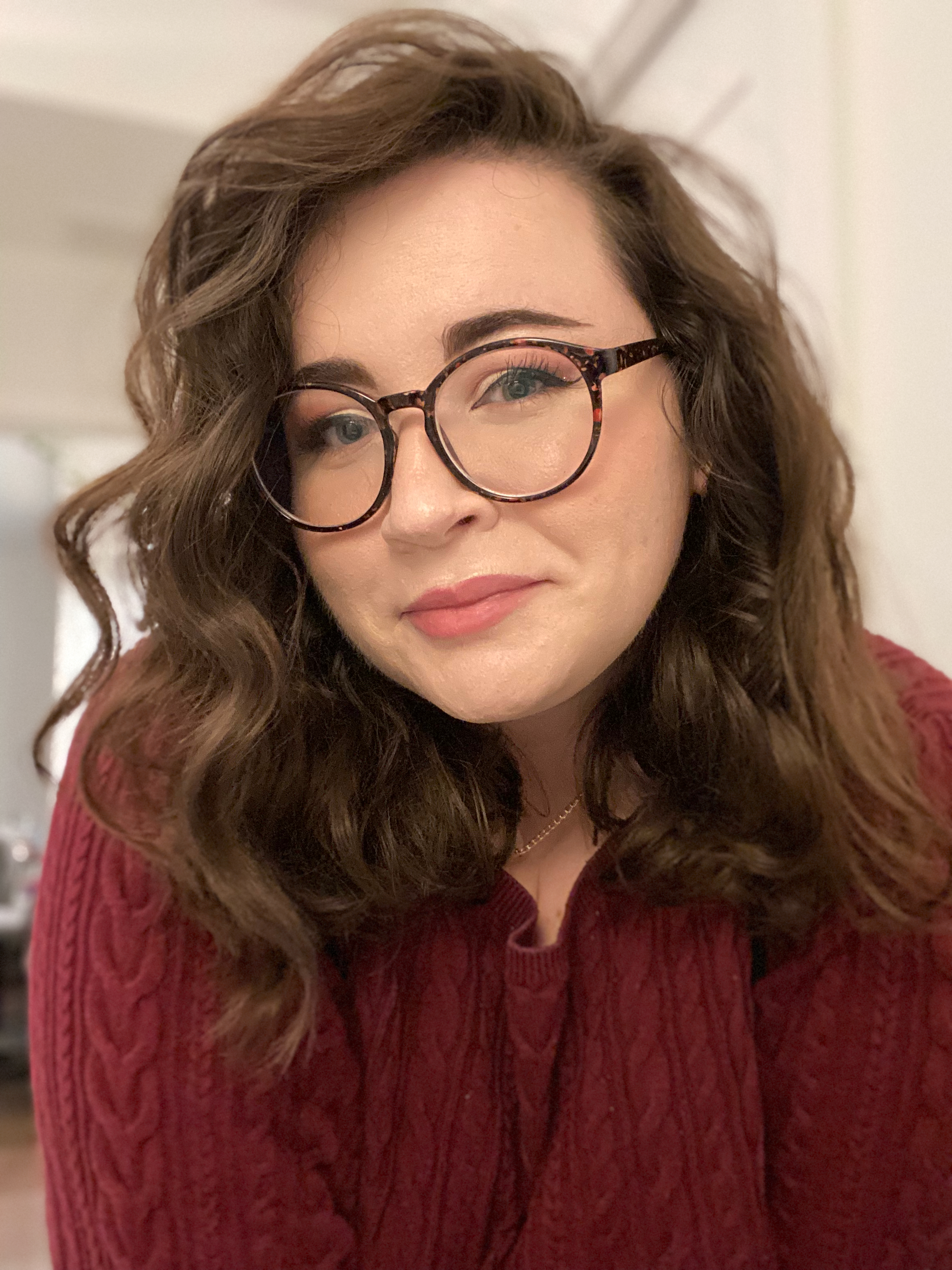
HANNAH SULLIVAN FACKNITZ
For the love of life with lupus | J. William Fulbright program alumna | Master of Arts, University of British Columbia | Former curator of antique textiles | Emerging scholar of di/convergence of crip and Indigenous histories | Access Pedagogy Professional
Pronouns: they/them, Mx.
Anti-Colonial Commitment:
I am descended from the first settlers to enter Haudenosaunee and Lenape territory in the late 16th century as well as a family of refugees who fled the collapse of the Weimar and the 1920s rise of fascism in Germany. They settled in the Council of Three Fires land in Detroit.
The refugees, like the colonizers of my lineage, however, all took up the project of settler colonialism once they arrived on this continent. Even my Irish and Scottish ancestors, fleeing the violent colonialism of 18th and 19th century Britain, became agents of colonial violence in what became the US and Canada. I am inextricably enmeshed in five hundred years of colonial violence, even now as my work tries to take apart the institutions that enable it.
Today, I live on the occupied lands of the xʷməθkʷəy̓əm where the main structural footprint of UBC has forcibly dislocated and continues to displace xʷməθkʷəy̓əm, səlilwətaɬ, and Skwxwú7mesh knowledge in favour of colonial knowledge. I owe these peoples and many others across North America whose lands I personally or my ancestors have stolen in the last 500 years a debt so enormous the only possible repayment is the end of settler colonialism, one of the largest disabling structures in history. Disability work is always, by necessity and imperative, about decolonial and anti-colonial work. There is no disabled liberation without the fall of colonialism.
Queer, disabled, settler, scholar
I am a professional historian, working in intersectional and interdisciplinary medical humanities, disability studies, and Indigenous studies. I am also a queer, disabled community activist. My activism and scholarship are deeply intertwined, as accurate, community-oriented, care & kinship informed histories can change the world. With expertise in accessible pedagogy & education, public health history and planning, and the academic disciplines of history, sociology, English, public health, education, and political science, my work is dislocated, in many ways, from a neat academic home. I love this about my work. The academy and its structures do not. I am an experienced writer beyond academe, too, writing creative non-fiction, fiction, poetry, and essays. Much of my current efforts revolve around theoretical synthesis and translating academic material to broader audiences in plain language. I work in open access, universal design pedagogies, and larger justice-oriented approaches to research, teaching, and academia writ-large. I am particularly interested in building community capacity for self-determination, advocacy, and safety.
My recent scholarship has had somewhat divergent trajectories. With Danielle E. Lorenz (Alberta), I have been working on advancing the ongoing work of accessible pedagogy during crisis learning. We have a forthcoming chapter in Reading Sociology: Unsettling a Settler Colonial Project and Re/writing Sociological Narratives and published with Active History in 2021. We are also working on a forthcoming paper with sarah madoka currie for the Canadian Journal of Higher Education‘s special issue on perspectives of marginalized students. This work falls under my commitments as what Danielle, sarah, and I call “academic crip doula” obligations. Crip doulas are spiritual, emotive, and physical partners in community that help people navigate the structural and institutional barriers of disabled like. Danielle, sarah, and I attempt to do this with students and others in higher education, working in partnership and kinship to mitigate the harm of these institutions.

I have continued my graduate thesis work on the municipal colonial dispossession of the Skwxwú7mesh on the North Shore of the Burrard Inlet at the same time. Completion of my thesis is anticipated in March 2022, with graduation in May. My undergraduate thesis “Performing Authentic Savagery: National Myth-Making and Indigenous Survival at American World’s Fairs, 1893-1904” won the Phi Kappa Phi Best Thesis Award at James Madison University.
I’ve presented my research across North America and the United Kingdom in Oklahoma, Virginia, British Columbia, Alberta, and Cambridge, among others, and have the privilege of a transnational network of mentors, peers, and kin. I have also studied in Japan, Ghana, the United Kingdom, and Canada. At James Madison University, I graduated magna cum laude with distinction in history and am a member of Phi Beta Kappa, Phi Kappa Phi, and Phi Alpha Theta.
Currently, I work as a Gender+ Research Guide Developer in the Officer of Regional and International Engagement at UBC and as a teaching assistant for the Department of History. I have been an educator for nearly 15 years and wake up every day humbled by the privilege of teaching so many diverse, intelligent, world-changing students. I’ve worked, too, in suicidology, as an accounting assistant, and a curator of the Virginia Quilt Museum. Previous jobs have included being the youth advisor for the growing youth group of Trinity Presbyterian Church and a service worker for my local food co-op. For several years, I also worked full-time as a textile artist.
You can find my complete curriculum vitae here.

Photo credit: David Kreider
I am an artist and activist as well as a scholar engaging with the life-giving and radical communities of disabled, queer, and BIPOC knowledge-creators. My intellectual, spiritual, and physical lives are deeply indebted to the generosity of these communities that I do and do not embody. I hold a deep conviction that history is a social justice discipline—that telling accurate history opens the door to liberation.
“Seeing is not believing—seeing must be a question of ethics and an acknowledgement of the politics of representation that implicates the historian as witness to past vulnerabilities intimately connected to the present.”
Jane Nicolas, “A Debt to the Dead? Ethics, Photography, History, and the Study of Freakery,” Histoire Sociale 47, no. 93 (May 2014): 154.
 hannah sullivan facknitz